
Introducing Friedman.ai
Explore Milton Friedman's Insights (with Caution)

We are thrilled to announce the launch of friedman.ai, a new platform that lets anyone engage in conversation with the late Milton Friedman, or rather, an AI that channels his iconic economic wisdom. Our goal is to make the insights of Milton Friedman easily accessible to all, transcending the boundaries of time.
Why Friedman.ai?
Our initial experiments with FriedmanGPT, shared on this Substack, aimed to gauge how well AI could capture the essence of Friedman's thoughts on contemporary issues. We intend to continue posting FriedmanGPT’s insights about important issues and comparing and contrasting the result with output from vanilla ChatGPT. However, the positive feedback and intriguing discussions that followed our initial post clearly indicated that people were eager to interact with the model directly. Thus, friedman.ai was born, a dedicated platform where users can directly interact with the AI, posing questions ranging from economic policies to societal changes, and receive responses infused with Friedman's perspective.
Far from perfect
We wanted to launch Friedman.ai as quickly as possible, and we are doing so with full knowledge of its many imperfections. As we detailed in our original post to this Substack, one of the ways we induce Friedmanesque responses from the system is by selecting relevant data about Friedman from a dataset we have built and delivering it as context along with the original prompt. This approach is very effective in cases where our dataset contains information directly pertinent to the user’s query, and the system can sometimes even extrapolate from Friedman’s known position on a topic (e.g., the importance of individual liberty) to topics on which Friedman likely never espoused a direct view (e.g., critical race theory). However, the further away a queried topic is from the examples of Friedman’s positions in our dataset, the more likely the system is to revert back to its default (i.e., vanilla ChatGPT) position on topics. These positions are sometimes antithetical to Friedman’s views. We are in the process of collecting and curating more data on Milton Friedman and we expect the system to improve in real time. But don’t be surprised if you occasionally get responses that are clearly (and sometimes comically) uncharacteristic of the actual Milton Friedman, particularly during the next few weeks as we continue to grow our Milton Friedman dataset.
Maximizing Outcomes with Friedman.AI: A User's Guide
Friedman.AI, akin to a formula, generates responses based on a combination of the input, context related to the input, and the chat history. The key to effective prompts is specificity. Here’s how to craft them for the best results:
Be Specific: Detailed instructions yield better responses. Instead of vague requests, guide the AI with clear, precise prompts. For example, rather than saying "Write a poem about your friends," specify, "Write a three-stanza poem about friends like Arthur and George, focusing on meaningful content over imagery or rhyme."
Follow-Up Questions: When seeking new insights or connecting previous responses to new queries, clarity is crucial. Direct the AI to consider new information by explicitly stating what needs to be addressed. A good follow-up question not only recaps the previous topic but also introduces the new element you want explored, ensuring a coherent and informed continuation of the discussion.
Illustrative Examples:
Effective Prompting: "Provide unique insights about the below paper on (topic). Offer insightful comments on specific aspects you find notable, without summarizing the paper."
Follow-Up Strategy: To build on previous discussions, guide the AI by stating, "Considering your previous thoughts on (X), how does (Y) influence or relate to that perspective?"
By adhering to these principles, users can enhance their interactions with Friedman.AI, leading to more accurate, relevant, and insightful responses.
Help us improve
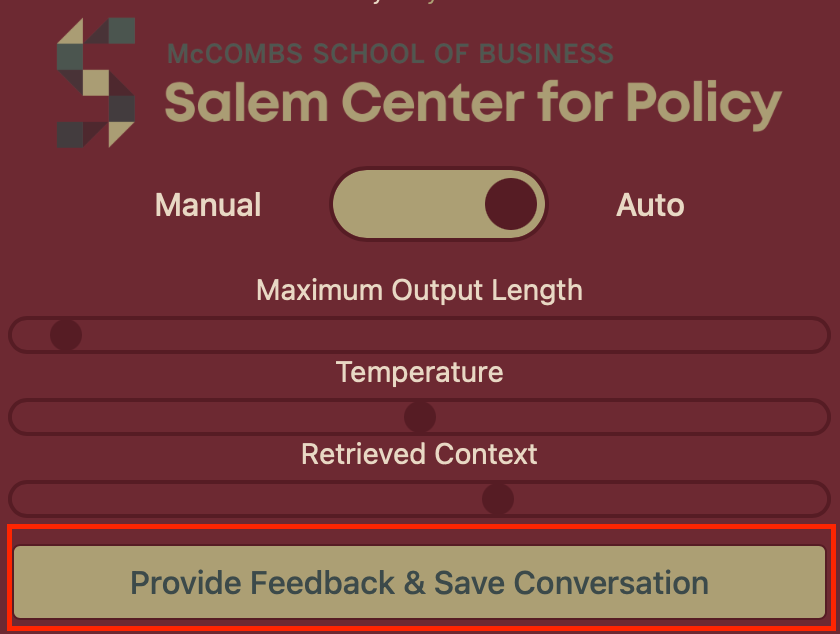
Besides collecting more data on Milton Friedman, we hope to improve the model through user feedback. If you use friedman.ai, please also make use of the “Provide Feedback and Save Conversation” button (pictured below) to let us know how the model is performing.
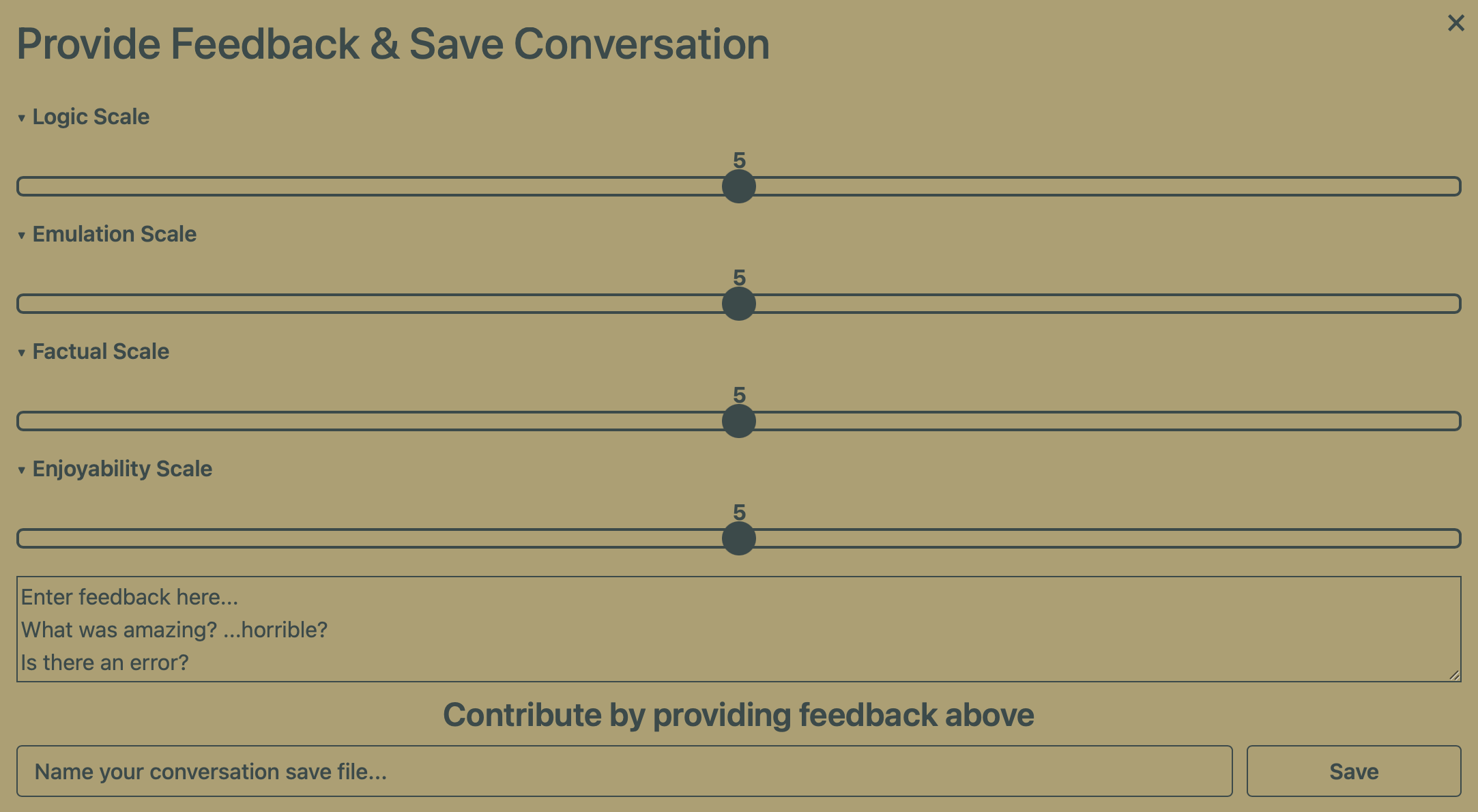
You will be presented with a form that requests ratings on a few dimensions of performance (pictured below). You can use the triangle beside each dimension to get a more detail explanation of the type of feedback we are looking for. But in each case, we are most interested in identifying responses that fall in the tails of the distribution: i.e., responses that are very good or very bad. There is also a place for you to provide written feedback. When you are finished filling out the form, don’t forget to hit the “Save” button in the bottom right to submit your feedback. We will be incorporating these responses back into the model in close to real-time.
Looking forward
Milton Friedman's contributions to economics and his advocacy for freedom and choice have left an indelible mark on the world. Through friedman.ai, we aim to continue his legacy, sparking conversations and debates that push the boundaries of conventional thinking. This platform is not just about looking back; it's about applying timeless wisdom to navigate the complexities of our current era. We look forward to continuing to make friedman.ai better, and to one day leveraging what we learn on this project to breathe new life into the work of other luminaries. Thanks for your interest and support.